
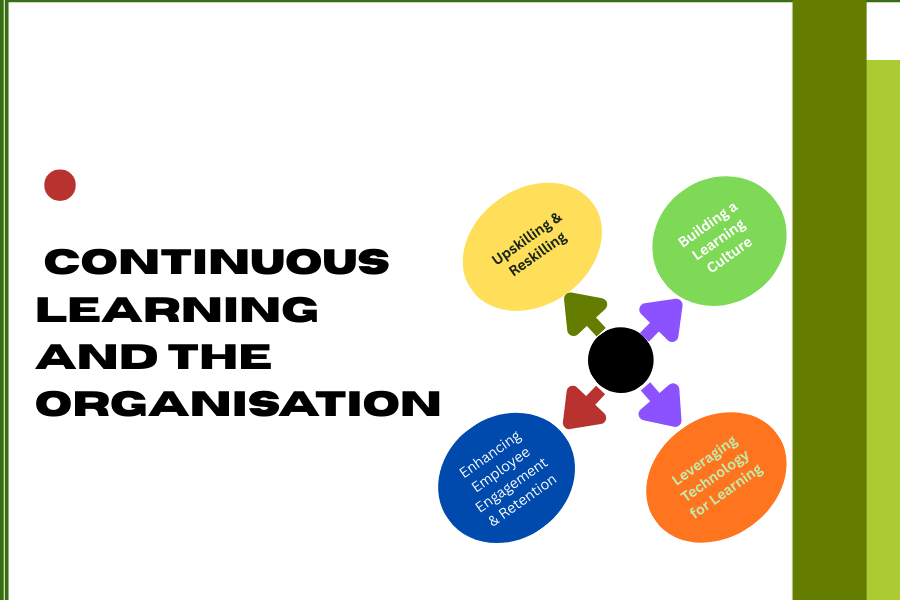
Competitive advantage no longer depends only on goods, prices, or marketing tactics in the fast-paced business world of today. Rather, it is becoming more and more linked to people: the staff members who solve difficult problems, foster innovation, and provide customer experiences. Employees in organizations must constantly adjust to new business models, changing market demands, and emerging technologies if they are to stay resilient and relevant.
This is where continuous learning comes in. Far from being a corporate buzzword, continuous learning has become a strategic necessity. In addition to being more inventive, companies that make investments in professional development, upskilling, and reskilling are also better positioned to hold onto top talent, lower operational risks, and sustain long-term growth.
1. Why Continuous Learning Matters
The world of work is evolving at an unprecedented pace. Skills that were in demand five years ago may already be outdated today. According to industry research, over 50% of employees will need significant reskilling and upskilling in the next three years due to technological advancements like automation and artificial intelligence.
This means one thing for businesses: without a culture of lifelong learning, organizations risk losing their competitive edge and employees risk falling behind. Teams that engage in continuous learning are more flexible and able to satisfy changing client and business demands.
2. The Link Between Learning and Innovation
Competitiveness depends on innovation. Curiosity, experimentation, and creativity are fostered by companies that support continuous learning. Workers who are exposed to new information and viewpoints are more likely to come up with original ideas and find creative answers to problems.
For instance, tech firms that make significant investments in ongoing education, through innovation labs, design thinking workshops, and coding boot camps, frequently take the lead in creating ground-breaking goods and services. Innovation is a natural outcome when learning is ingrained in company culture.
3. Upskilling and Reskilling for the Future of Work
Jobs in many industries have been redefined by the rise of digital transformation. While some roles run the risk of becoming outdated, others, like those in data analytics, cybersecurity, and artificial intelligence, are developing quickly. Businesses need to dedicate themselves to both in order to stay competitive:
• Upskilling: It is the process of improving an employee’s present abilities to increase their effectiveness in their positions.
• Reskilling: It is the process of educating staff members to assume completely new responsibilities that correspond with changing business requirements.
Businesses can lessen their reliance on external hiring, which is frequently expensive, time-consuming, and unpredictable, by concentrating on their own employee development. Rather, they create a workforce that is future ready and can adapt easily.
4. Enhancing Employee Engagement and Retention
Continuous learning helps people as well as businesses. Employees are more motivated, engaged, and loyal when they see their company investing in their growth.
Studies show that organizations with strong learning cultures report higher employee retention and lower turnover rates. Employees now remain with organizations where they perceive career development opportunities rather than just job security. By supporting professional growth, businesses strengthen both morale and retention, which translates into a stronger bottom line.
5. Building a Learning Culture
It takes more than just holding periodic training sessions to establish a learning culture. It is about embedding learning into the DNA of the organization. To achieve this, leaders must:
• Encourage employees to take ownership of their career development.
• Provide access to e-learning platforms, mentorship programs, and workshops.
• Acknowledge and honor the sharing of knowledge and the development of skills.
• Make learning part of daily work practices rather than a one-time occurrence.
Employees are encouraged to experiment and take chances when learning is viewed as a shared value, which increases business competitiveness.
6. Leveraging Technology for Learning
Learning is now easier than ever thanks to the powerful tools available to modern businesses. Digital learning platforms, mobile apps, webinars, and virtual classrooms allow employees to learn at their own pace, anytime and anywhere.
Personalized learning paths can be created with the use of Artificial Intelligence (AI), checkout this article which suggests training courses according to each employee’s particular career objectives and skill gaps. By embracing digital learning solutions, companies can scale professional development efficiently while reducing costs.
7. Continuous Learning as a Competitive Advantage
Prioritizing learning offers organizations a number of distinct advantages:
• Agility: They quickly adjust to shifting market conditions.
• Innovation: They come up with original solutions that are difficult for rivals to match..
• Talent Attraction: They attract ambitious professionals who value growth.
• Resilience: They are better prepared to weather economic downturns and industry disruptions.
In short, learning becomes a competitive advantage. In a market where products and services can be replicated, a skilled and adaptive workforce cannot.
8. Measuring the Impact of Continuous Learning
Organizations must assess the impact of continuous learning in order to optimize its advantages. Useful metrics include:
• Employee performance and productivity improvements.
• Innovation rates (e.g., new ideas, patents, or solutions created).
• Retention and turnover statistics.
• Customer satisfaction and loyalty scores.
When businesses track these outcomes, they can refine their learning strategies, ensuring that investments in training and development deliver measurable results.
Check here for continuous learning
Conclusion
Continuous learning is the key to long-term business success in a world that is characterized by constant change. Companies that commit to upskilling, reskilling, and cultivating a growth culture are not only more innovative but also more competitive.
By leveraging technology, encouraging employee engagement, and embedding lifelong learning into everyday work practices, businesses can stay ahead of the curve. The future will belong to organizations that recognize learning not as an option but as a strategic advantage.
0 Comments